D—LAB
Bauhaus Design Labor
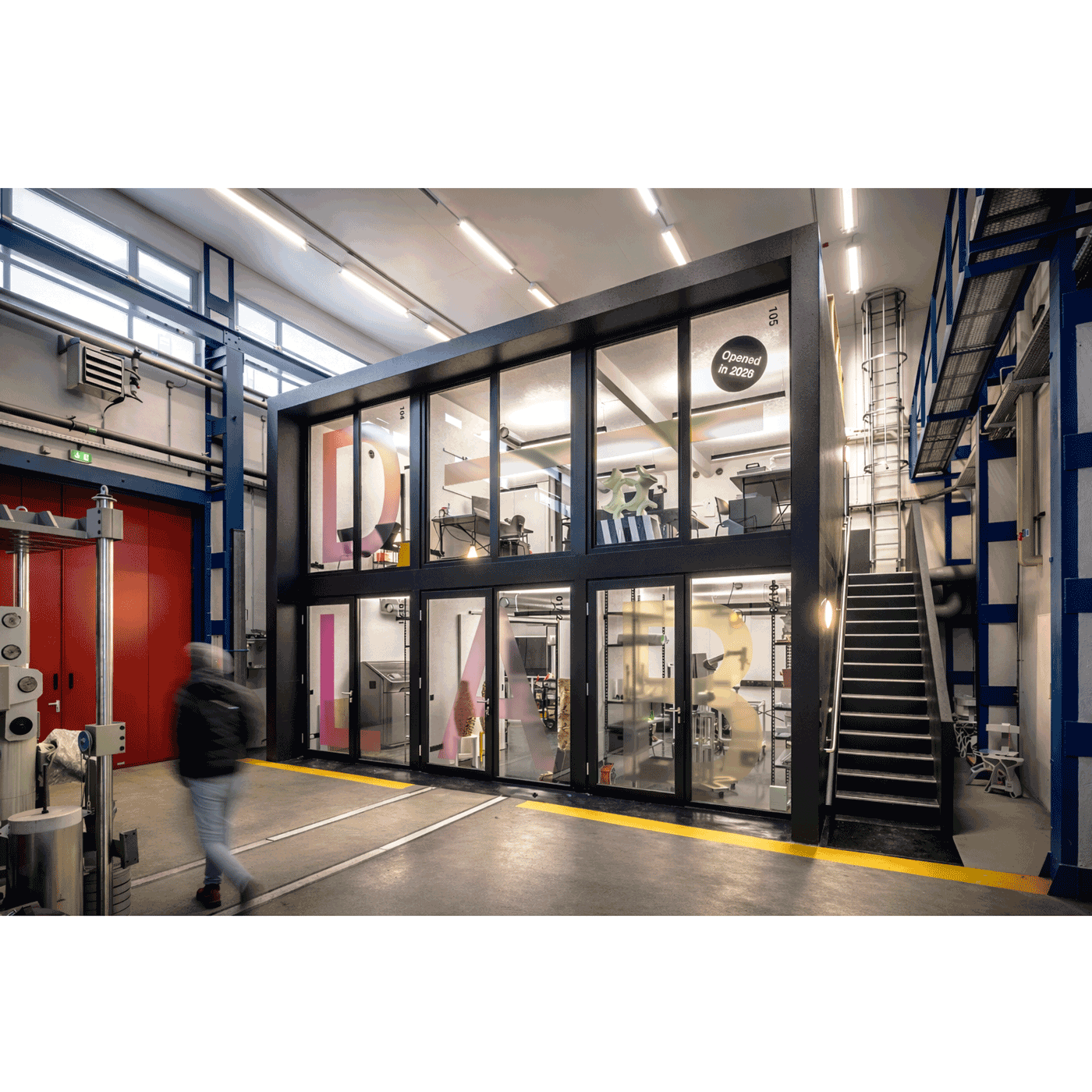
Mit dem Bauhaus Design Labor (D–LAB) wurde an der Bauhaus-Universität Weimar eine neue Plattform für praxisbasierte, interdisziplinäre und technologisch erweiterte Designforschung geschaffen. Das Labor ist an der Professur Designtheorie und Designforschung von Prof. Dr. Jan Willmann angesiedelt und verbindet Ansätze aus Design-, Ingenieur- und Kulturwissenschaften mit experimentellen, entwurfsbasierten und empirischen Forschungsprozessen.
Im Zentrum stehen insbesondere Fragestellungen, die sich aus dem Zusammenspiel von Gestaltung, Technologie, Material, Produktion und gesellschaftlichem Wandel ergeben. Forschungsschwerpunkte umfassen unter anderem Digital Epistemology, Algorithmic Materiality, Computerized Human-Centred Design, Distributed Authorship, Artificial Intelligence, Human-Machine Interaction und Creative Robotics. Dabei dient das D–LAB nicht allein als technische Infrastruktur, sondern als Forschungsumgebung, in der theoretische Reflexion, experimentelle Praxis und technologische Entwicklung systematisch miteinander verbunden werden.
Die unmittelbar auf dem Hauptcampus der Bauhaus-Universität Weimar gelegenen Räumlichkeiten wurden als flexible Forschungs-, Arbeits-, Lehr- und Präsentationsumgebung konzipiert. Zur technischen Infrastruktur gehören unter anderem robotische Systeme, additive und subtraktive Fertigungstechnologien sowie weitere digitale Produktions- und Bearbeitungsverfahren. Die räumliche und technische Ausstattung ist so angelegt, dass unterschiedliche Forschungsfragen, Projektformate und technologische Anforderungen aufgenommen und flexibel weiterentwickelt werden können.
Ein besonderer Schwerpunkt liegt auf der Entwicklung und Erprobung neuer entwurfs- und forschungsmethodischer Ansätze. Das D–LAB ermöglicht hierzu die Verbindung digitaler Entwurfsprozesse mit materiellen Experimenten, robotischer Fertigung, prototypischer Entwicklung und physischer Evaluation. Dadurch entstehen Arbeitsprozesse, in denen Gestaltung nicht nur als Ergebnis, sondern zugleich als Erkenntnis- und Forschungsinstrument verstanden wird.
Darüber hinaus fungiert das D–LAB als Ort der Vernetzung, Vermittlung und öffentlichen Präsentation. Forschungsvorhaben und experimentelle Arbeiten können hier entwickelt, dokumentiert und ausgestellt sowie in den Austausch mit anderen wissenschaftlichen Disziplinen, kulturellen Institutionen und gesellschaftlichen Akteur*innen gebracht werden. Das Labor versteht sich damit zugleich als Schnittstelle zwischen universitärer Forschung, experimenteller Gestaltungspraxis und öffentlichem Diskurs.
Der Aufbau des D–LAB umfasste die konzeptionelle, räumliche, technische und organisatorische Entwicklung der neuen Forschungsinfrastruktur sowie deren Integration in Forschung und Lehre. Die Eröffnung des Labors erfolgte im Sommer 2026.
/
The Bauhaus Design Laboratory (D–LAB) was established at Bauhaus-Universität Weimar as a new platform for practice-based, interdisciplinary, and technologically expanded design research. Situated within the Chair of Design Theory and Design Research led by Prof. Dr. Jan Willmann, the laboratory brings together approaches from design, engineering, and the cultural sciences with experimental, design-based, and empirical research processes.
At its core, the D–LAB investigates questions emerging from the interplay of design, technology, materiality, production, and societal transformation. Its research areas include Digital Epistemology, Algorithmic Materiality, Computerized Human-Centred Design, Distributed Authorship, Artificial Intelligence, Human-Machine Interaction, and Creative Robotics. The D–LAB is conceived not merely as a technical infrastructure, but as a research environment in which theoretical reflection, experimental practice, and technological development are systematically interconnected.
Located directly on the main campus of Bauhaus-Universität Weimar, the laboratory was conceived as a flexible environment for research, work, teaching, and presentation. Its technical infrastructure includes robotic systems, additive and subtractive manufacturing technologies, as well as further digital production and machining processes. The spatial and technical setup is designed to accommodate diverse research questions, project formats, and technological requirements, while allowing the infrastructure to evolve in response to changing needs.
A particular focus lies on the development and testing of new design and research methodologies. The D–LAB enables digital design processes to be combined with material experimentation, robotic fabrication, prototyping, and physical evaluation. In this context, design is understood not only as an outcome, but also as a means of inquiry and a research instrument in its own right.
Beyond its role as a research environment, the D–LAB also functions as a place for networking, knowledge transfer, and public presentation. Research projects and experimental work can be developed, documented, exhibited, and brought into dialogue with other academic disciplines, cultural institutions, and broader societal actors. In this way, the laboratory operates as an interface between university-based research, experimental design practice, and public discourse.
The development of the D–LAB began in 2025 and comprised the conceptual, spatial, technical, and organisational development of the new research infrastructure as well as its integration into research and teaching. The laboratory opened in summer 2026.
Credits:
Team (Professur):
Prof. Dr. Jan Willmann
Dr. Michael Braun
Koordination Aufbau und Implementierung:
Dr. Michael Braun
Projektleitung (Professur):
Prof. Dr. Jan Willmann
Professur Designtheorie und Designforschung
Bauhaus-Universität Weimar
Expert*innen:
Servicezentrum Liegenschaften der Bauhaus-Universität Weimar
Kooperation:
Planungsgruppe Fölsche GmbH
Art:
Infrastrukturprojekt
